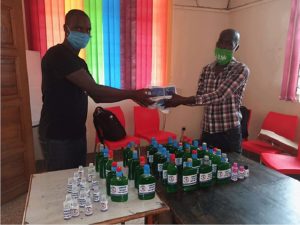
In this interview with Parinita Bhattacharjee, she talks about the stigma and discrimination experienced by men who have sex in men (MSM) in Kenya. Covid-19 has exacerbated the difficulties faced by MSM, as well as hindered the delivery of HIV care and services. Read the Q&A to find out about the innovative steps made by MSM led organisations to adapt to the challenges created by Covid-19 and provide the necessary clinical and social support.
Sam Dorevitch, University of Illinois, US, sought to provide safe drinking water to communities using an entirely solar-powered approach for water treatment. In this blog, Yousuf Al-Mousawi, Senior Editorial Assistant, discusses the research and the system.
As Editorial Assistants, our peer reviewers will often say to us “I won’t review the Study Protocol, but I will review the results”, which made us wonder why Study Protocols are disregarded by some? In this blog post, Charlie Vickers, Senior Editorial Assistant, explains why Study Protocols are important – not only for science in general, but as part of the Gates Open Research model too.
Inequalities can result in barriers to good health and unacceptable differences in healthcare. In this blog post, Dominic Montagu, professor of epidemiology and biostatistics at University of California, San Francisco, discusses the research carried out by he and his co-authors, Lauren Suchman and Charlotte Avery Seefeld. Compelled by the importance to better our understanding of the drivers of inequality and the potential changes within health systems that could mitigate inequity.
Prabhat Jha, a professor at the University of Toronto Dalla Lana School of Public Health and the founding director of the Centre for Global Health Research, at St. Michael’s Hospital and University of Toronto. His research interests include large scale epidemiology studies of the major causes of death in developing countries, and methods of epidemiological…
This week (19-25 October) is Open Access Week, and the theme for 2020 is “Open with Purpose: Taking Action to Build Structural Equity and Inclusion.” Gates Open Research is committed to listening to researchers and responding to their needs to create a better, more inclusive publishing experience. Here, we introduce a new policy that allows researchers to retroactively change their names on articles and assets.
In this blog post Michael Markie, Publishing Director at F1000 Research, outlines the upcoming adjustments to the pricing structure on Gates Open Research, whilst Ashley Farley, Program Officer of Knowledge and Research Services at the Bill and Melinda Gates Foundation discusses the importance of price and service transparency of the platform and how this aligns with the Plan S principles.
In our second blog post for Peer Review Week, the Peer Review Team talk about how we build trust between our authors, reviewers and the wider research community, discussing our author-led process, which means no editorial bias, and going through the revision and response process here at Gates Open Research.
As this week (21st-25th September) marks Peer Review Week, the Peer Review Team delve into the meaning of this year’s theme of ‘Trust in Peer Review’ and explore how our transparent peer review process is ideally suited to building trust.
In this blog, Emily MacLean, McGill University, discusses the tuberculosis (TB) landscape and the barriers to the adoption of diagnostic tests for TB.