Six years of supporting Gates-funded open research
| 28 March, 2023 | Abbie Nicholson |
2023 marks six years of Gates Open Research – the innovative publishing platform launched by the Bill & Melinda Gates Foundation to support Gates grantees in publishing their findings openly and transparently.
In our blog, we explore how the open research landscape has changed since 2017, how the Foundation’s open research policies continue to evolve, the role of Gates Open Research in supporting researchers globally, and some of the key publishing highlights from the last six years.
The changing landscape of open research
Gates Open Research was launched in 2017 when open research and open access publishing was increasingly gaining momentum in the global research community.
According to OA.Works, 2.18 million articles were published open access in that year around the world. That number has since risen to 3.71 million publications in 2021 and 3.91 million publications in 2022 – a 70% and 79% increase respectively.
Some of this may be attributed to the so-called ‘Covid spike’ in research, which highlighted the need for a more open and transparent publishing model during rapidly evolving global health threats, and it’s clear that open access publishing continues to increase its footing among researchers, funders, and institutions alike.
Most recently in the United States, the Office of Science and Technology Policy (OSTP) Memo sparked renewed conversation around open access and open science by mandating that all federally funded research be made freely accessible without an embargo.
“[The OSTP Memo] is a chance to catch up with other parts of the world (Europe, Australia, Netherlands, Latin America, etc.) that have been prioritizing and delivering on open science for many years now.
One reason this announcement is so important is that it confirms the conviction of many who have taken risks and pushed against the status quo with the inherent belief that change is necessary. This is a proof point that the work and sacrifices made are creating momentum and advancements.”
Ashley Farley, Gates Foundation Open Access Lead in a thought piece for Upstream.
Gates Foundation support for open research
The Gates Foundation is committed to global knowledge-sharing and transparency, with open access publishing and open research playing a key role in this.
This was cemented in the introduction of an Open Access Policy in 2015, mandating that all published research resulting from foundation funding must be published openly and without delay, ensuring the unrestricted access and reuse of all research and datasets.
The Open Access Policy is one part of the foundation’s Information Sharing Approach and Global Access Statement, which underpins the commitment to ensuring that all outcomes from foundation funding are widely accessible.
Beyond its own policies, the foundation has been an active player in open research and open science for many years, becoming an early adopter of cOAlition S in 2018, an initiative to make full and immediate open access to research publications a reality.
This commitment to cOAlition S was furthered in 2021, when the Open Access Policy was updated in line with Plan S to mean that author fees are only be covered for grantees publishing their work in a fully open access or transformative journal.
“The perception of open research has shifted each year towards becoming an accepted and necessary practice for the benefit of research. The obstacles and barriers to adopting open research habits have decreased drastically each year.
I am proud that Gates Open Research has provided a platform for grantee authors to embrace open research practices and see how it improves and extends the impact of their work. My hope is for this momentum to grow and strengthen as technology and cultural advances allow researchers to leave the status quo behind.
To me, the greatest value of Gates Open Research is collecting successful examples of sharing knowledge in a way that better benefits the research and researchers.”
Ashley Farley, Gates Foundation Open Access Lead
Spotlight on open data
Open data is increasingly acknowledged as a key element of open research, with an emphasis on transparent data-sharing and reuse.
The FAIR guiding principles outline a framework for sharing data in a way that is Findable, Accessible, Interoperable, and Reusable, with many researchers beginning to implement this in their own work.
This has been furthered by a number of national and international mandates. The OSTP Memo also extends to underlying datasets, while the US National Institute of Health (NIH) introduced its Data Management and Sharing Policy in 2020, which came into effect earlier this year, and champions data sharing for all NIH-funded research.
Open data has been a major part of the foundation’s Open Access Policy, with all Gates-funded researchers required to provide a Data Availability Statement that describes where any primary data, associated metadata, original software, and any additional relevant materials can be found, alongside their research. In addition, there is recognition of the need to better support researchers with data sharing throughout a research project, not just for publication, with ongoing work in this area at the foundation, including data sharing output plan piloting.
On Gates Open Research, our data-sharing policies match those of the foundation, for example endorsing FAIR Data Principles, requiring authors to share their underlying data in an open repository, and requiring authors to provide a Data Availability Statement with all published research. In addition, our editorial supports authors in this aim, advising on all aspects of data sharing and writing Data Availability Statements.
Highlights from six years of publishing with Gates Open Research
Gates Open Research is a key component of the foundation’s support for open research, providing a fully open access publishing venue for all Gates-funded research with no author-facing fees.
Supporting 11 different article types to enable researchers to publish their work at every stage of the research project, the Platform is underpinned by open data and open peer review, with a focus on research-level metrics rather than journal impact factors to help advance changes in research assessment. In the past six years, over 3,000 authors from 402 different institutions and 82 different countries have published their research with the Platform, with over 420 articles covering everything from education and family planning to agriculture and infectious disease.
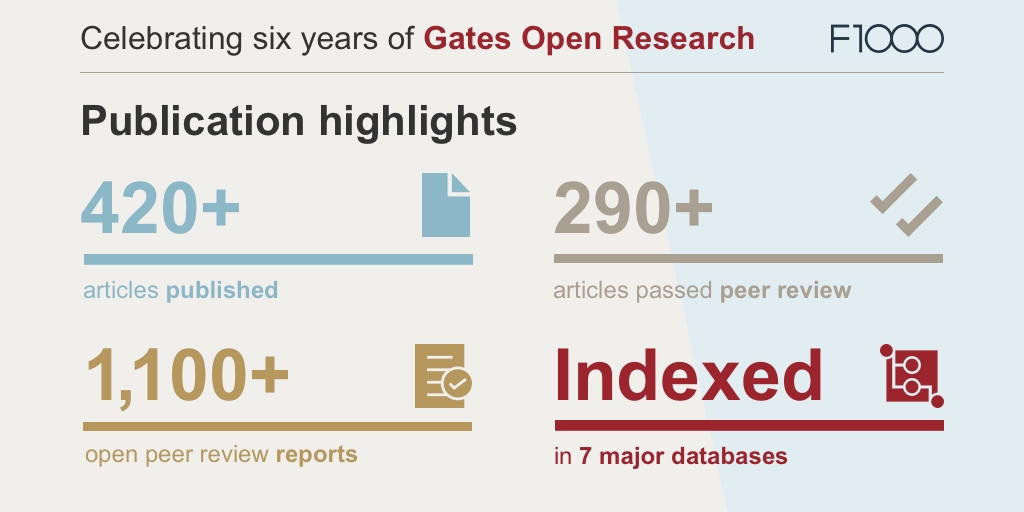

Authors have embraced the ability to publish their research outputs at every stage of the research journey through diverse article types, with 59% of research published as a traditional Research Article, and the other 41% made up of non-traditional article types such as Study Protocols and Open Letters.

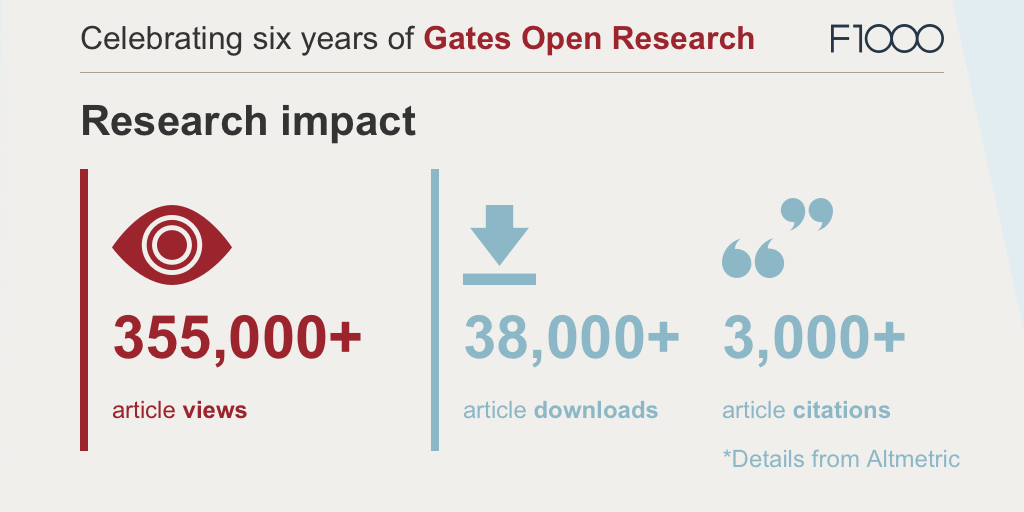
Publishing work open access has also helped amplify the reach of Gates-funded researchers, with over 355,000 article views, over 38,000 article downloads, and over 3,000 article citations across the Platform, including coverage in news outlets such as Forbes and the New York Times, and citations by international policymakers such as the World Health Organization.
Publish your own research with Gates Open Research
Gates Open Research will continue to evolve to meet the changing needs of Gates-funded researchers and the global open research landscape more widely, adapting its existing policies to focus on greater equity, reusability, and sustainability of open research.
If you’re ready to join the thousands of Gates-funded researchers already publishing with Gates Open Research, find out more about the Platform and submit your research today.


COMMENTS