Embracing openness in research with Gates Open Research
| 22 October, 2024 | Jack Nash |

Open research is gaining momentum in today’s research landscape. With more authors interested in the accessibility, reproducibility and transparency of their work, they need to consider where to publish their academic outputs. Launched by the Bill and Melinda Gates Foundation in 2017, Gates Open Research publishes results originating from Gates Foundation-funded research. Gates Open Research is a peer-reviewed publishing service that advocates for the principles of open science by offering eligible authors an efficient and impactful option for publishing their research in full compliance with the open access requirements set out in their grant agreement.
Since 2017, Gates Open Research has experienced many successes, and the platform has gone from strength to strength. More than 500 papers have been published on the platform so far, and many of those have gone on to indexing in Google Scholar, among others.
How open is Gates Open Research?
The answer is very open indeed! All the policies are clearly described on the website, including details on price transparency, explaining what the article processing charge that the Gates Foundation pays per article is used for. Some examples of openness on Gates Open Research includes accepting a diverse array of article types, requiring that any associated data be made openly accessible alongside the articles, and employing open peer review as part of the publishing model.
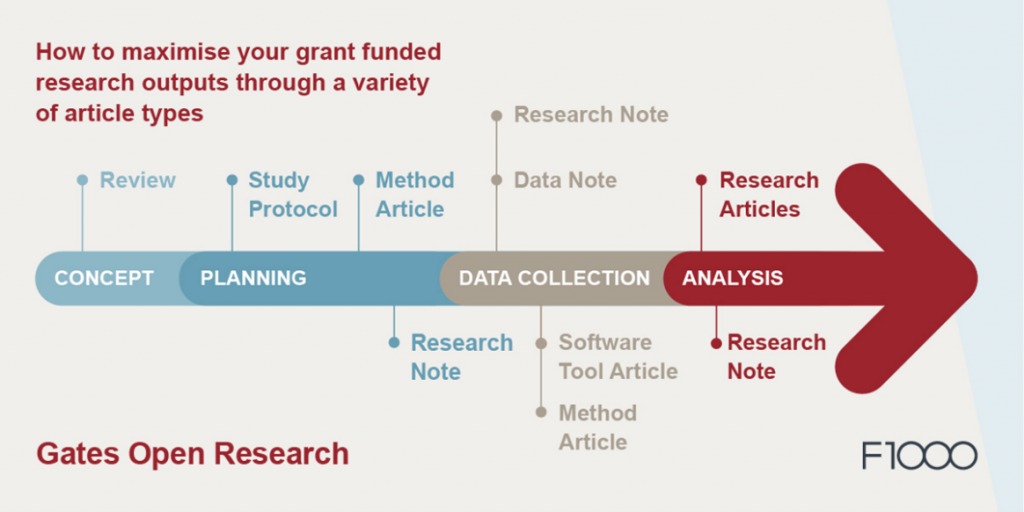
A huge amount of work goes into every research project, and too often much of that work never makes it into the final Research Article. Perhaps it does not fit the narrative of your Research Article, or maybe the word limit is too restrictive. This can lead to this work being left unshared, despite the value it may still have to other researchers. If others were able to utilise this research, it may still influence any work they are planning or prevent them from unknowingly, and perhaps unnecessarily, repeating the work. Gates Open Research offers authors the opportunity to share their work as a variety of article types; providing the option to publish every aspect of their research project, from conception to the final Research Article.
Publishing other outputs other than Research Articles allows for a much deeper analysis and review of each stage of the project and, subsequently, a much richer academic discussion. This is particularly relevant for Method Articles as the method section of a Research Article is often shortened. Research Articles play a vital role in the research journey, but by focussing only on them, we undermine the potential value of other outputs that can be published.
Open data
Open data means freely and openly sharing any information or materials that have been collected, created, or reused as part of a research project. It can take many forms including survey results, observational data, gene sequences, archival material, photographs, software, code, neuro-images, and audio files. Choosing to publish data openly benefits not only the research team, but also the wider research community and society as a whole.
By providing access to comprehensive information about data, source materials, and code, other researchers can more easily reproduce the research step-by-step. This can help to corroborate the findings and, in turn, build trust in the results. When others can replicate and validate research, it ensures that conclusions are built upon a firm foundation. In turn, this boosts the credibility of research and robustness within the research community and with stakeholders. Similarly, sharing data and supporting information openly provides opportunities for richer feedback during peer review. Researchers can identify opportunities for collaboration with others who are interested in the data.
In line with the Gates Foundation’s funding policies, Gates Open Research’s open data policy supports the FAIR Data principles as a framework to promote the broadest reuse of research data and secure its longevity. Our open data policy aims to ensure that research data is made ‘as open as possible, as closed as necessary’. This means that all data and supporting materials must be shared unless there are commercial, privacy, security, or confidentiality concerns.

Open peer review
Open peer review is one approach to peer review. Within that, there are many different varieties of open review practices, so not all open peer review processes look the same. Open practices can include:
Open identities: authors and reviewers are aware of each other’s identities.
Open reports: review reports are published alongside the relevant article.
Open participation: the wider scholarly community can contribute to the review process.
Open interaction: direct reciprocal discussion between author(s) and reviewers, and/or between reviewers, is allowed and encouraged.
Open final version commenting: reviewing or commenting on the final “version of record”.
Open platforms (“decoupled review”): review is facilitated by a different organisational entity than the venue of publication.
Fostering an open peer review model with transparency at its core is increasing in popularity in academic publishing, and Gates Open Research is proud to be leading the charge into the future of peer review. Open peer review at Gates Open Research is:
- Post publication, with articles published before peer review is undertaken
- Fully open, with reviewer identities, affiliations, and reports being published alongside articles
- Applied across all outputs, including non-traditional article types such as Method Articles, Data Notes, Study Protocols, and more, and focuses on the soundness of science over author reputation or perceived novelty
- Collaborative, with the option for early career researchers to work with senior researchers by co-reviewing articles.
One of the key benefits of post-publication peer review for academic research is its ability to speed up publishing times and subsequently accelerate research impact. Transparency in the peer review process adds accountability and gives credit to the reviewers by publicising their names and reviews.
Authors are also aware of who is reviewing their articles, which can help build the author’s trust in the feedback they receive and confirm the reviewer’s expertise.
Submit your research to Gates Open Research
Join the hundreds of authors who are already publishing openly with Gates Open Research!


COMMENTS