How can we balance research integrity with post-publication peer review?
| 26 July, 2023 | Abbie Nicholson |

One of the primary issues with traditional publishing models is the speed – or lack thereof – of publication. Some articles face delays of several months, or even years, between submission and publication, with peer review taking up much of this time.
These lengthy delays are one of the driving factors of the post-publication peer review model that underpins Gates Open Research. This model means that articles are published before peer review, with an initial article version made available with a DOI.
But how does this differ from a preprint server? And how can we balance post-publication peer review with maintaining research integrity?
We explore this below.
Problems with traditional peer review models
Traditional publishing models follow a pre-publication closed peer review model, with the article only published after passing peer review.
These delays can mean that findings become outdated in the time it takes for peer review to complete. This causes particular concern for rapidly evolving research fields, including global health situations such as COVID-19.
In these situations, the research community must share their research as quickly as possible to accelerate the pace of discovery.
The rise of preprints
While preprints are not a new tool for researchers, preprint servers in the medical and health disciplines grew during the pandemic. They increasingly became a dissemination route for findings that needed to be shared as quickly as possible.
However, there are concerns over trust in research published on existing preprint servers when findings don’t stand up to scientific scrutiny during later peer review, or require retraction.
This can result in mistrust in the original research and undermine any other research built upon the original findings.
As a result, we need new models enabling research to be published more quickly than traditional models while maintaining research integrity.
Combining a new peer review model with research integrity
Gates Open Research’s post-publication peer review model helps to reduce publishing delays from peer review while operating several editorial and open research practices that ensure the integrity of research published on the platform.
Publishing an initial version of an article before peer review may draw some similarities to existing preprint servers, but there are three key differences in the Gates Open Research model:
- An editorial team who conducts editorial checks on all submissions before being approved for publication.
- Invited peer review, with all approved articles subject to peer review by experts in their field.
- An open data policy, which requires all authors to make their underlying data openly available, where possible, as part of the submission process.
Find out more about how this model supports research integrity below.
Pre-publication editorial checks
To ensure the quality of the papers published on Gates Open Research, our Editorial team conducts rigorous pre-publication checks on all submissions.
Our professional editors ensure that all articles adhere to the platform’s guidelines and policies, with these policies informed by international publishing standards.
These checks include:
- Author criteria – at least one author is funded or co-funded by the Gates Foundation, or has been in the past, and that the article is a result of this funding
- Plagiarism – the work has not been published previously or is under consideration or review elsewhere.
- Methods – authors have provided details of all methods and resources and confirm whether more information would be required to reproduce the research.
- Language and readability – readers can easily follow the information presented and arguments made.
- Policies – all articles comply with the platform’s policies, including ethics, trial registrations, competing interests, and more.
- Open data – authors have shared all underlying data of an article and a Data Availability Statement when submitting the article.
Our editors only approve articles that pass these checks for publication on the platform. This ensures that quality is maintained and that the research community can have greater trust in the findings.
Find out more about these publishing requirements on Gates Open Research.

Open peer review
Another pillar of the Gates Open Research model that supports research integrity is invited peer review, which is also an open process.
Not only are experts invited to review every published article on the platform, but the names and review reports are published openly alongside the article.
This openness ensures that all reviewers are publicly accountable for their feedback, which can reduce the potential for bias and produce higher quality, more constructive peer review reports.
Similarly, it allows readers to understand the reasoning behind peer review decisions, enabling a deeper understanding of the research and its findings and an opportunity for learning across the entire research community.
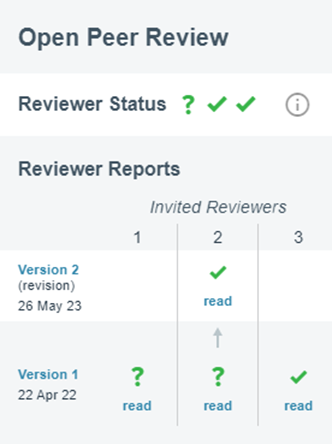
To pass peer review, an article must receive two ‘Approved’ statuses or two ‘Approved with reservations’ and one ‘Approved’ status. These peer review decisions are displayed on each article, which helps readers understand the soundness of the article at first glance.
Find out more about open peer review.
Versioning
Papers that do not meet this threshold for peer review require a new version and subsequent review to pass peer review. Similarly, authors can produce a new version of an approved article at any time they feel appropriate, for example, when new evidence comes to light.
Articles are versioned transparently on Gates Open Research, with version numbers displayed against the latest version and a separate DOI for each article.
In these new versions, we expect authors to respond to peer review comments, with original reviewers invited to review the new version and revise their approval status as appropriate.
This means the peer review and publication processes are entirely transparent and iterative. Authors, reviewers, and readers can learn and develop their understanding at every stage of an article’s lifecycle, driving greater trust in the subsequent research.
Open data
Finally, open data is central to Gates Open Research, and all authors must make their data openly available to publish on the platform.
Open data can play a crucial role in maintaining research integrity. It enables greater research transparency, allowing others to view the underlying datasets and validate the authenticity of reported results, which can help minimize the spread of unsound science.
Similarly, it helps others to reproduce the research more efficiently. Reproducing studies can show that the research and its methods are robust or uncover errors and faulty methods. This can bolster the strength of the research or prevent the dissemination of unsound research.
Find out more about the value of open data in our previous blog.
Publish your research with Gates Open Research
If you’d like to benefit from this new publishing model, reducing publishing delays while maintaining research integrity, you can publish your Gates-funded research at no cost today.
Find out more about the publication process, or contact the editorial team with further questions.


COMMENTS