How to maximize research outputs by publishing diverse article types
| 30 May, 2023 | Abbie Nicholson |

Research Articles are often seen as the primary, and sometimes only, choice for researchers when publishing their work. However, this singular focus on final papers – by both authors and publishers alike – can overshadow the value of the unpublished, and often underappreciated, underlying work that forms the majority of a research project.
In this blog, we’re exploring why it’s important to broaden the scope of publishable work for authors, and how researchers can maximize their research outputs through publishing a variety of article types.
Supporting diverse article types
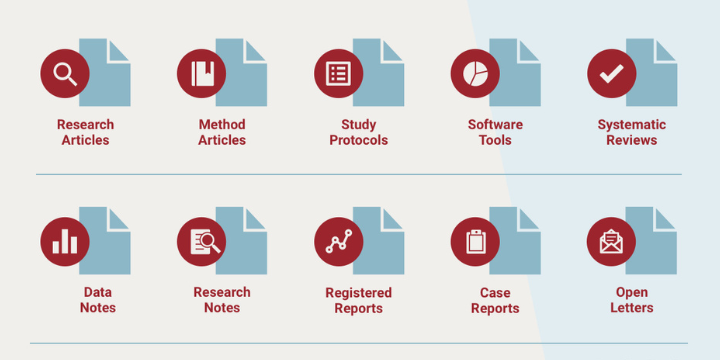
To help researchers maximize the broad range of research outputs that stem from every project, Gates Open Research supports 10 different article types, which enable researchers to publish results and analysis at every stage of the research lifecycle.
From Data Notes and Method Articles to Open Letters and Case Reports, these diverse article types broaden the scope of publishable work for researchers and increase visibility of these less traditional research outputs.
You can find further detail about the formats and contents of some of these article types in a previous blog, where we provided an overview of some of the diverse article types supported by Gates Open Research, with insights into Method Articles, Data Notes, Study Protocols, and more.
The benefits of publishing diverse article types for researchers
Broadening the scope of publishable research outputs and shifting the sole focus away from Research Articles has several benefits for researchers.
1. Get credit for every stage of a project
Research projects are often long, complex, and made up of several detailed steps that require data collection, investigation, analysis, report writing and more. And yet, only a small snapshot of this work makes it into the final Research Article.
As a result, much of this foundational work remains unpublished and unrecognized by the wider research community.
By publishing every output of a research project as a standalone article type, whether it’s methods in a Method Article, data in a Data Note, or pre-research investigation in a Systematic Review, researchers can get full credit for the hard work that goes into each step of a project.
2. Reduce research waste and inefficiencies
Tied to this increase in recognition is a reduction in research waste and inefficiencies.
By publishing outputs at every stage, the research community – and wider stakeholders – can access and analyse this underlying research that would otherwise be archived and, arguably, wasted.
As a result, other researchers can build on the foundations of each stage in their own studies, helping to reduce unnecessary repetition of research and accelerate the speed of new discoveries.
3. Increase reproducibility and trust in research
Documenting the full research process can also help to enhance the reproducibility of research, which in turn can help to increase trust in the findings.
By providing access to all research outputs, the entire research project becomes much more transparent. Other researchers can follow the study step-by-step – and in more depth – to reproduce and validate the original findings.
This means others can ensure that conclusions are built upon a firm foundation, boosting the research’s credibility and building trust. This can also help to increase the chance of research being cited, replicated, and used by wider stakeholders, including policymakers.
4. Improve project quality
Furthermore, publishing early research outputs can help authors produce higher-quality research.
Every article on Gates Open Research is peer reviewed, which means that publishing early work provides an opportunity for experts to help improve research as it evolves, as well as flag and minimize any potential issues that could become a concern further down the line.
For example, the opportunity to submit Study Protocols to get feedback on study design before research begins can help researchers, especially early career researchers, to make adjustments early on to improve the quality of their research.
Not only does this result in higher-quality research, but it can also save time and effort in mitigating potential issues as they arise.
5. Provide more in-depth analysis and enable richer peer review
Similarly, publishing research outputs as their own dedicated article allows for a much deeper analysis and discussion of each stage.
Where methods, data, software, literature reviews, and other outputs would traditionally have a small part in a final Research Article, publishing this work as an article in its own right provides space for more in-depth analysis and discussion. This can, in turn, enable much richer peer review through a more comprehensive understanding of the research.
6. Increase research visibility
Finally, publishing all research outputs as a dedicated article type can help boost research visibility.
Each article published on Gates Open Research has its own DOI and is indexed in industry databases when it passes peer review. As a result, each of these articles is discoverable in its own right, meaning readers can find a research project via many different routes rather than just through the final Research Article.
This can also lead to more citations and a potential boost in real-world impact, with an increased chance of research being discovered and used by stakeholders outside of the immediate research community.
Publishing outputs at every stage of a research project
Each article type supported by Gates Open Research relates to a different step of the research journey.
From Systematic Reviews, Study Protocols, and Method Articles during the concept and planning stages to Data Notes, Software Tool Articles and Research Notes during the data collection and analysis stages, the diverse article types support different outputs across the full project lifecycle.
Discover how some of the article types relate to different outputs in the infographic below.

Publish your research with Gates Open Research
Gates-funded researchers are eligible to publish their work with Gates Open Research at no cost to themselves, with article types available to support outputs at every stage of the journey.
Find out more about these diverse article types in our article guidelines, and submit your research for publication today.


COMMENTS