Gates Open Research – A summary of year four
| 23 March, 2021 | Ashley Farley |

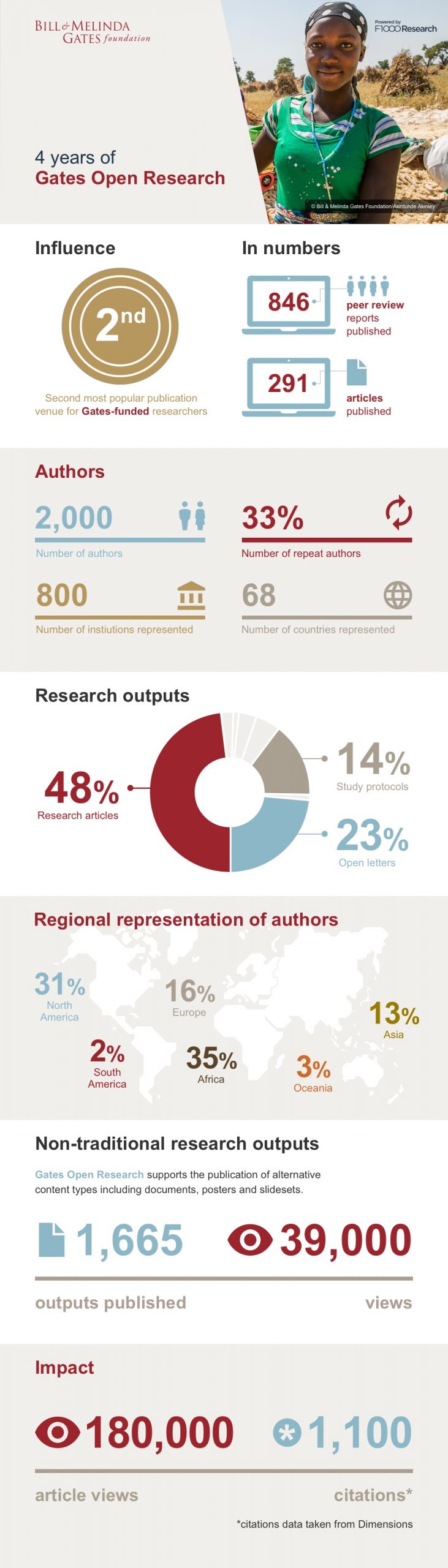
2021 marks four years of publishing on Gates Open Research, now the 2nd most popular publication venue for Gates-funded researchers. In this blog post, Ashley Farley, Program Officer of Knowledge and Research Services at the Bill and Melinda Gates Foundation, explores the publishing activity for the last year and the platform’s growth in popularity and size.
We are pleased that more authors are choosing to publish with us, hosting the work of 2000 published authors, a third of whom have published at least twice. Since launch, we have published 291 articles and 846 peer review reports, which are all assigned a DOI.
Research Articles remain our most popular peer reviewed article type, representing 48% of the published work. We’ve seen a rise in other article types, publishing more Open Letters and Study Protocols, at 23% and 15% respectively. We see the value in non-traditional article types, and this increase shows how researchers can benefit from the flexibility of communicating research beyond the standard research article, which isn’t necessarily the best or most appropriate format to convey research. Representing a smaller proportion but no less important are Method Articles, Software Tools and Research Notes at 5%, 4% and 2% respectively.
Covid-19 increases the pace of science publishing
Since the launch of the platform four years ago, our author-led publication model has provided Gates Foundation grantees a place to rapidly publish their articles. We’ve acknowledged the importance of accessibility and making information quickly available for the benefit of the global community. When the Covid-19 pandemic hit, it forced a greater change in the pace of scientific publishing, particularly for health research, where speed became an increasing priority. It’s important that we learn from these changes to improve publishing processes and make them the norm.
In part we attribute the growth we’ve seen in Open Letters as a response to the global crisis because the article type gives authors the ability to rapidly communicate information they feel is of importance, without the constraints of other publishing formats. As the platform is author-driven there are no rejections due to scope or article type providing authors a way to quickly share important information without barriers One such example we’d like to highlight is this Open Letter ‘Clinical trials in the pandemic age: What is fit for purpose?’ by Hartman et al, from the Bill & Melinda Gates Medical Research Institute, Wellcome Trust and Open Global Health. The authors introduced a portal to collect data on applications and proposals for future clinical trials, so that they could be evaluated for potential interventions and help guide scalable solutions.
“The strength of this article is that it addresses an interesting and timely question on how to deal with the challenges of conducting clinical trials during a pandemic, and finds a novel solution based on a carefully selected set of potential recommended actions,” says Ndansi Elvis Nukam, Unite for Health Foundation, New York City, USA, in their peer review report of the article.
Another Open Letter to showcase, discusses the stigma and discrimination experienced by men who have sex in men (MSM) in Kenya and how the difficulties faced by the community have been exacerbated by the pandemic. Parinita Bhattacharjee, University of Manitoba, Canada, co-authored the article with a group of authors including community researchers, who describe how Covid-19 has hindered the delivery of HIV care and services. “Open research means higher and quicker accessibility and visibility of new knowledge or information,” says Bhattacharjee in her Q&A about the benefit of open research for discussing HIV testing amid Covid-19 and how organizations have had to adapt to provide necessary services.
The value in alternative research outputs for knowledge sharing
We believe all outputs are worth sharing, which is why Gates Open Research supports the publication of alternative content types, including documents, posters and slides. We are proud that we have published 1665 of these outputs, which have gained an impressive 39,000 views. These figures show the importance of these non-peer reviewed outputs. Although typically overlooked by traditional journals, as they’re not considered novel findings, we recognize that these outputs are highly valued by the foundation programme staff and grantees. The benefits of these for knowledge sharing and the sheer appetite for documents, slides and conference posters is most apparent in The Water, Sanitation & Hygiene gateway. We want to support our progamme staff and grantees by ensuring all aspects of the projects funded by the foundation are made available and easily shareable.
Our ongoing commitment to a more inclusive publishing experience
We are committed to responding to our authors’ needs to create a more inclusive publishing experience. Last year, we introduced our new policy that allows researchers to change their names on articles and assets. The simple, fair and unobtrusive workflow means that authors who wish to change their names on their own publications may simply request a name change through the editorial office. The Gates Open Research production team will be responsible for resending files to indexers to reflect the name change in databases, such as PubMed, guaranteeing that researchers maintain credit for their work.
Our commitment to diversity and inclusion is ongoing as we continue to explore ways that we can better support our authors. We are pleased to see the platform’s global appeal increase, representing authors from over 800 different institutions in 68 countries. One of our focus areas for 2021 is to better consider how we can support all members of our global author base, in particular those who may face more barriers to publishing or lack resources.
To finish, we’d like to announce our two new Advisors who we welcomed this year: Carly Strasser from Chan Zuckerberg Initiative and Jean Christophe Rusatira from the Bill & Melinda Gates Institute for Population and Reproductive Health at Johns Hopkins Bloomberg School of Public Health. We look forward to the new perspectives Carly and Jean Christophe will bring to our Advisory Board and look forward to working with them, alongside our existing Advisors, to continue to develop and promote Gates Open Research.
We are open to hearing from the community on how to improve Gates Open Research and what we can do to create a better publishing experience. Please do get in touch, we welcome all ideas and feedback, so that we can provide services that reflects the needs of our users.


COMMENTS